श्रीमद्भगवद्गीताBhagavad Gītā · in the light of Sri Aurobindo, home

Chapter XVIII78 verses

अथाष्टादशोऽध्यायः

मोक्षसंन्यासयोगः

The Yoga of the Renunciation of Liberation

Mokṣa-saṁnyāsa-yoga

Abandon all dharmas and take refuge in the Beloved alone; he will deliver thee from all sin and evil: grieve not, and rejoice again and again. — The Delight of Krishna

The soul enters in
oṃ tat sat — sacrifice, gift and askesis offered to the Real
and is led towards
mām ekaṃ śaraṇaṃ vraja — refuge in the Divine alone, and a delight that rejoices again and again

Recitations

  1. Swami Sarvagananda ji0:00
  2. Ashit Desai0:00
In this chapter

78 verses

Summary of chapter 18

I. The Gunas. Mind and Works (1-39)

The Glta enters Into a summary psychological anatysls of the mental powers before it proceeds to its great finale, the highest secret which is that of a spiritual exceeding of all dharrnas.

II. Swabhava and Swadharma (40-48)

In this section the Gita deals with an incidental question of great importance - the ancient social idea of chaturvamya, which was a very different thing from the present day caste system.

III. Towards the Supreme Secret (49-58)

In this section the Gita re-states the body of its message.

IV. The Supreme Secret (57-78)

The essence of the teaching and the Yoga has thus been given to the disciple and the divine Teacher now proceeds to apply to his action. Attached to a crucial example, spoken to the protagonist of Kurukshetra, the words bear a much wider significance and are a universal rule for all who are ready to ascend above the ordinary mentality and to live and act in the highest spiritual consciousness.
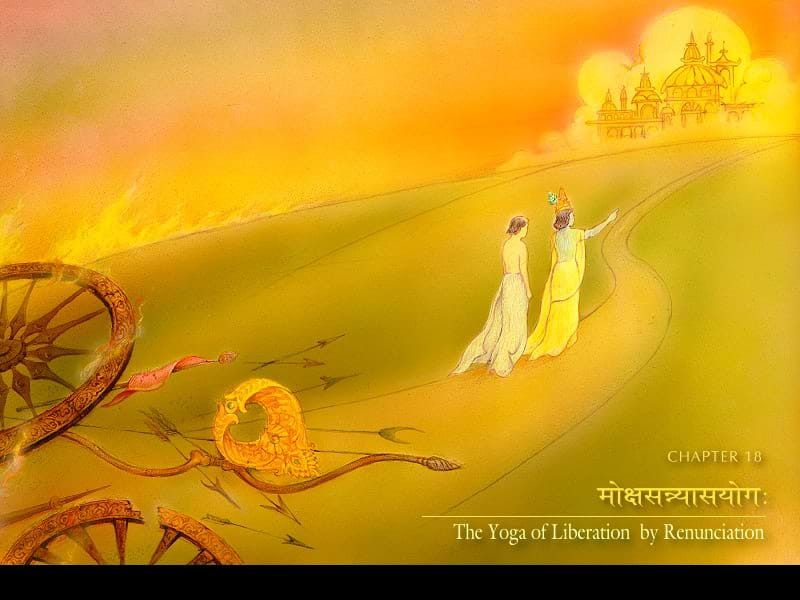
Chapter 18 illustration, titled मोक्षसंन्यासयोगः
Illustration · Sushanto Nath, Sri Aurobindo Society

Chapter outline

Choose a range to read just those verses.

  1. 18·1–12sannyésa and mega differentiated; three qualities of tyéga.
  2. 18·13–17The five determinants of Action.
  3. 18·18–28The Knowledge, the Action, the Deer according to the three Gunas.
  4. 18·29–35Intelligence and persistence of will according to the three Gunas.
  5. 18·36–39Pleasures according to the three Gunas.
  6. 18·40–48The specific works of the four types of people (caturvarnva); Spiritual perfection through and according to one's own nature and work.
  7. 18·49–58Rightly oriented spiritual discipline culminating in bhakti.
  8. 18·59–60The force of personal nature.
  9. 18·61–63The all governing God within; integral surrender to Him.
  10. 18·64–66The supreme Word of the Master.
  11. 18·67–73The importance of the secret Knowledge of the Gita; Arjuna's complete rehabilitation and his pledge to do the Divine's bidding.
  12. 18·74–78Sanjava's thrilling recollections and his conviction regarding glory and victory to the Lord with His hero disciple.
  13. 18·1–78Show all 78 verses

The verses

Showing verses 1–12 of 78 · Show all 78 verses

Arjuna uvācaअर्जुन उवाच

  1. 18·1संन्यासस्य महाबाहो तत्त्वमिच्छामि वेदितुम् । त्यागस्य च हृषीकेश पृथक्केशिनिषूदन ॥ १ ॥saṁnyāsasya mahābāho tattvamicchāmi veditum, tyāgasya ca hṛṣīkeśa pṛthakkeśiniṣūdana.I desire, O mighty-armed, to know the principle of Sannyasa and the principle of Tyaga, O Hrishikesha, and…

Śrī Bhagavān uvācaश्रीभगवानुवाच

  1. 18·2काम्यानां कर्मणां न्यासं संन्यासं कवयो विदुः । सर्वकर्मफलत्यागं प्राहुस्त्यागं विचक्षणाः ॥ २ ॥kāmyānāṁ karmaṇāṁ nyāsaṁ saṁnyāsaṁ kavayo viduḥ, sarvakarmaphalatyāgaṁ prāhustyāgaṁ vicakṣaṇāḥ.Sages have known as Sannyasa the physical depositing (or laying aside) of desirable actions…
  2. 18·3त्याज्यं दोषवदित्येके कर्म प्राहुर्मनीषिणः । यज्ञदानतपःकर्म न त्याज्यमिति चापरे ॥ ३ ॥tyājyaṁ doṣavadityeke karma prāhurmanīṣiṇaḥ, yajñadānatapaḥkarma na tyājyamiti cāpare.“All action should be relinquished as an evil”, declare some learned men…
  3. 18·4निश्चयं शृणु मे तत्र त्यागे भरतसत्तम । त्यागो हि पुरुषव्याघ्र त्रिविधः सम्प्रकीर्तितः ॥ ४ ॥niścayaṁ śṛṇu me tatra tyāge bharatasattama, tyāgo hi puruṣavyāghra trividhaḥ samprakīrtitaḥ.Hear my conclusions as to renunciation (Tyaga), O best of the Bharatas…
  4. 18·5यज्ञदानतपःकर्म न त्याज्यं कार्यमेव तत् । यज्ञो दानं तपश्चैव पावनानि मनीषिणाम् ॥ ५ ॥yajñadānatapaḥkarma na tyājyaṁ kāryameva tat, yajño dānaṁ tapaścaiva pāvanāni manīṣiṇām.Acts of sacrifice, giving and askesis ought not to be renounced at all, but should be performed, for they…
  5. 18·6एतान्यपि तु कर्माणि सङ्गं त्यक्त्वा फलानि च । कर्तव्यानीति मे पार्थ निश्चितं मतमुत्तमम् ॥ ६ ॥etānyapi tu karmāṇi saṅgaṁ tyaktvā phalāni ca, kartavyānīti me pārtha niścitaṁ matamuttamam.Even these actions certainly ought to be done, O Partha, leaving aside attachment and fruit.
  6. 18·7नियतस्य तु संन्यासः कर्मणो नोपपद्यते । मोहात्तस्य परित्यागस्तामसः परिकीर्तितः ॥ ७ ॥niyatasya tu saṁnyāsaḥ karmaṇo nopapadyate, mohāttasya parityāgastāmasaḥ parikīrtitaḥ.Verily, renunciation of tightly regulated actions is not proper, to renounce them from ignorance is a tamasic…
  7. 18·8दुःखमित्येव यत्कर्म कायक्लेशभयात्त्यजेत् । स कृत्वा राजसं त्यागं नैव त्यागफलं लभेत् ॥ ८ ॥duḥkhamityeva yatkarma kāyakleśabhayāttyajet, sa kṛtvā rājasaṁ tyāgaṁ naiva tyāgaphalaṁ labhet.He who gives up works because they bring sorrow or are trouble to the flesh, thus doing rajasic renunciation…
  8. 18·9कार्यमित्येव यत्कर्म नियतं क्रियतेऽर्जुन । सङ्गं त्यक्त्वा फलं चैव स त्यागः सात्त्विको मतः ॥ ९ ॥kāryamityeva yatkarma niyataṁ kriyate’rjuna, saṅgaṁ tyaktvā phalaṁ caiva sa tyāgaḥ sāttviko mataḥ.He who performs a rightly regulated action, because it has to be done, without any attachment either to the…
  9. 18·10न द्वेष्ट्यकुशलं कर्म कुशले नानुषज्जते । त्यागी सत्त्वसमाविष्टो मेधावी छिन्नसंशयः ॥ १० ॥na dveṣṭyakuśalaṁ karma kuśale nānuṣajjate, tyāgī sattvasamāviṣṭo medhāvī chinnasaṁśayaḥ.The wise man with doubts cast away, who renounces in the light of the full sattwic mind, has no aversion to…
  10. 18·11न हि देहभृता शक्यं त्यक्तुं कर्माण्यशेषतः । यस्तु कर्मफलत्यागी स त्यागीत्यभिधीयते ॥ ११ ॥na hi dehabhṛtā śakyaṁ tyaktuṁ karmāṇyaśeṣataḥ, yastu karmaphalatyāgī sa tyāgītyabhidhīyate.Nor indeed can embodied beings renounce all works; verily he who gives up the fruit of action, he is said to…
  11. 18·12अनिष्टमिष्टं मिश्रं च त्रिविधं कर्मणः फलम् । भवत्यत्यागिनां प्रेत्य न तु संन्यासिनां क्वचित् ॥ १२ ॥aniṣṭamiṣṭaṁ miśraṁ ca trividhaṁ karmaṇaḥ phalam, bhavatyatyāgināṁ pretya na tu saṁnyāsināṁ kvacit.The three kinds of result, pleasant, unpleasant and mixed, in this or other worlds, in this or another life…

End of the chapter

ॐ तत्सदिति श्रीमद्भगवद्गीतासूपनिषत्सुब्रह्मविद्यायां योगशास्त्रे श्रीकृष्णार्जुनसंवादेमोक्षसंन्यासयोगो नाम अष्टादशोऽध्यायः ॥ १८॥

om tatsaditi śrīmadbhagavadgītāsūpaniṣatsubrahmavidyāyāṁ yogaśāstre śrīkṛṣṇārjunasaṁvādemokṣasaṁnyāsayogo nāma aṣṭādaśo’dhyāyaḥ

Thus, in the Upanishad sung by the Lord, the science of Brahman, the scripture of Yoga, the dialogue between Sri Krishna and Arjuna, ends the eighteenth chapter entitled “The Yoga of Liberation by Renunciation”

Go to a verse

  1. 1
  2. 2
  3. 3
  4. 4
  5. 5
  6. 6
  7. 7
  8. 8
  9. 9
  10. 10
  11. 11
  12. 12
  13. 13
  14. 14
  15. 15
  16. 16
  17. 17
  18. 18
  19. 19
  20. 20
  21. 21
  22. 22
  23. 23
  24. 24
  25. 25
  26. 26
  27. 27
  28. 28
  29. 29
  30. 30
  31. 31
  32. 32
  33. 33
  34. 34
  35. 35
  36. 36
  37. 37
  38. 38
  39. 39
  40. 40
  41. 41
  42. 42
  43. 43
  44. 44
  45. 45
  46. 46
  47. 47
  48. 48
  49. 49
  50. 50
  51. 51
  52. 52
  53. 53
  54. 54
  55. 55
  56. 56
  57. 57
  58. 58
  59. 59
  60. 60
  61. 61
  62. 62
  63. 63
  64. 64
  65. 65
  66. 66
  67. 67
  68. 68
  69. 69
  70. 70
  71. 71
  72. 72
  73. 73
  74. 74
  75. 75
  76. 76
  77. 77
  78. 78