श्रीमद्भगवद्गीताBhagavad Gītā · in the light of Sri Aurobindo, home

Chapter IV42 verses

अथ चतुर्थोऽध्यायः

ज्ञानकर्मसंन्यासयोगः

Knowledge, Works and Renunciation

Jñāna-karma-saṁnyāsa-yoga

He who descends into our birth descends that we may ascend into his; know his birth and his works, and your own become free. — The Delight of Krishna

The soul enters in
yajña — every work laid upon the altar as an offering to the Lord of works
and is led towards
divyaṃ janma karma — the divine birth and the divine works, known in their truth

Recitations

  1. Swami Sarvagananda ji0:00
  2. Ashit Desai0:00
In this chapter

42 verses

Summary of chapter 4

I. The Possibility and Purpose of Avatarhood (1-15)

The Divine Teacher, the Avatar, gives his own example, his own standard to Arjuna. In India the belief in the reality of the Avatar, the descent into form, the revelation of the Godhead in humanity, has grown up and persisted as a logical outcome of the Vedantic view of life and taken firm met in the consciousness of the race.

II. The Divine Worker (16-23)

Equality, impersonality, peace, joy and freedom -these are the signs which distinguish a divine worker; they are all profoundly subjective and do not depend on so outward a thing as doing or not doing works.

III. The Significance of Sacrifice (24-42)

The Gita brings out the inner meaning of the Vedic sacrifice, interpreting the secret symbolism of the ancient Vedic mystics.
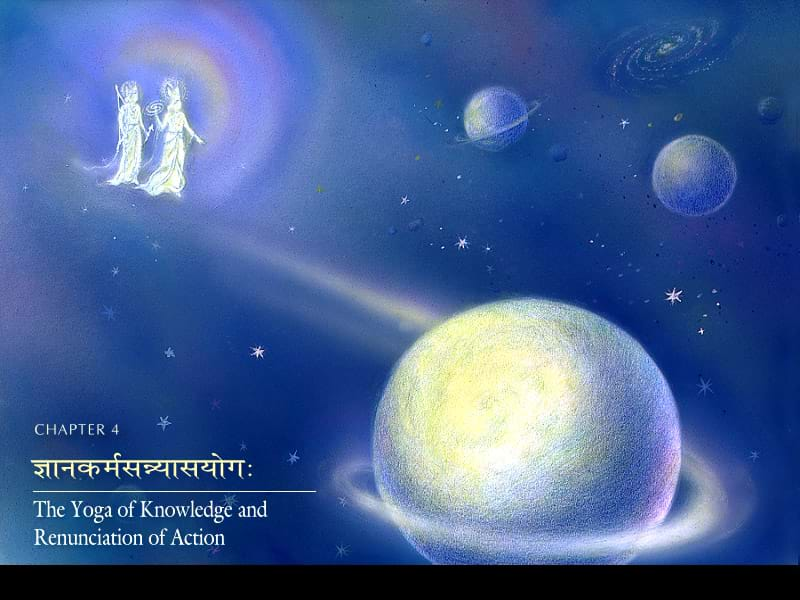
Chapter 4 illustration, titled ज्ञानकर्मसंन्यासयोगः
Illustration · Sushanto Nath, Sri Aurobindo Society

Chapter outline

Choose a range to read just those verses.

  1. 4·1–5The divine origin of the Gita's eternal Yoga.
  2. 4·6–15The truth and purpose of Avatarhood. Shri Krishna's self-revelation, His divine birth and action.
  3. 4·16–23The secret of Karma and Yoga.
  4. 4·24–33Various forms of Sacrifice, the divine principle of it.
  5. 4·34–42Spiritual Knowledge, its great value.
  6. 4·1–42Show all 42 verses

The verses

Showing verses 24–33 of 42 · Show all 42 verses

Śrī Bhagavān uvācaश्रीभगवानुवाच

  1. 4·24, a key verseब्रह्मार्पणं ब्रह्म हविर्ब्रह्माग्नौ ब्रह्मणा हुतम्‌ । ब्रह्मैव तेन गन्तव्यं ब्रह्मकर्मसमाधिना ॥ २४ ॥brahm’ārpaṇaṁ brahma havir-brahm’āgnau brahmaṇā hutam, brahm’aiva tena gantavyaṁ brahma-karma-samādhinā.Brahman is the giving, Brahman is the food-offering, by Brahman it is offered into the Brahman-fire, Brahman…
  2. 4·25दैवमेवापरे यज्ञं योगिनः पर्युपासते । ब्रह्माग्नावपरे यज्ञं यज्ञेनैवोपजुह्वति ॥ २५ ॥daivamevāpare yajñaṁ yoginaḥ paryupāsate, brahmāgnāvapare yajñaṁ yajñenaivopajuhvati.Some Yogins follow after the sacrifice which is of the gods…
  3. 4·26श्रोत्रादीनीन्द्रियाण्यन्ये संयमाग्निषु जुह्वति । शब्दादीन्विषयानन्य इन्द्रियाग्निषु जुह्वति ॥ २६ ॥śrotrādīnīndriyāṇyanye saṁyamāgniṣu juhvati, śabdādīnviṣayānanya indriyāgniṣu juhvati.Some offer hearing and the other senses into the fires of control, others offer sound and the other objects of…
  4. 4·27सर्वाणीन्द्रियकर्माणि प्राणकर्माणि चापरे । आत्मसंयमयोगाग्नौ जुह्वति ज्ञानदीपिते ॥ २७ ॥sarvāṇīndriyakarmāṇi prāṇakarmāṇi cāpare, ātmasaṁyamayogāgnau juhvati jñānadīpite.And others offer all the actions of the sense and all the actions of the vital force into the fire of the Yoga…
  5. 4·28द्रव्ययज्ञास्तपोयज्ञा योगयज्ञास्तथापरे । स्वाध्यायज्ञानयज्ञाश्च यतयः संशितव्रताः ॥ २८ ॥dravyayajñāstapoyajñā yogayajñāstathāpare, svādhyāyajñānayajñāśca yatayaḥ saṁśitavratāḥ.The offering of the striver after perfection may be material and physical (dravyayajña, like that consecrated…
  6. 4·29अपाने जुह्वति प्राणं प्राणेऽपानं तथापरे । प्राणापानगती रुद्ध्वा प्राणायामपरायणाः ॥ २९ ॥apāne juhvati prāṇaṁ prāṇe’pānaṁ tathāpare, prāṇāpānagatī ruddhvā prāṇāyāmaparāyaṇāḥ.Others again who are devoted to controlling the breath, having restrained the Prana (the outgoing breath) and…
  7. 4·30अपरे नियताहाराः प्राणान्प्राणेषु जुह्वति । सर्वेऽप्येते यज्ञविदो यज्ञक्षपितकल्मषाः ॥ ३० ॥apare niyatāhārāḥ prāṇānprāṇeṣu juhvati, sarve’pyete yajñavido yajñakṣapitakalmaṣāḥ.Others having regulated the food pour as sacrifice their life-breaths into life-breaths.
  8. 4·31यज्ञशिष्टामृतभुजो यान्ति ब्रह्म सनातनम् । नायं लोकोऽस्त्ययज्ञस्य कुतोऽन्यः कुरुसत्तम ॥ ३१ ॥yajñaśiṣṭāmṛtabhujo yānti brahma sanātanam, nāyaṁ loko’styayajñasya kuto’nyaḥ kurusattama.O best of the Kurus, they who enjoy the nectar of immortality left over from the sacrifice attain to the…
  9. 4·32एवं बहुविधा यज्ञा वितता ब्रह्मणो मुखे । कर्मजान्विद्धि तान्सर्वानेवं ज्ञात्वा विमोक्ष्यसे ॥ ३२ ॥evaṁ bahuvidhā yajñā vitatā brahmaṇo mukhe, karmajānviddhi tānsarvānevaṁ jñātvā vimokṣyase.Therefore all these and many other forms of sacrifice have been extended in the mouth of the Brahman (the…
  10. 4·33, a key verseश्रेयान्द्रव्यमयाद्यज्ञाज्ज्ञानयज्ञः परन्तप । सर्वं कर्माखिलं पार्थ ज्ञाने परिसमाप्यते ॥ ३३ ॥śreyāndravyamayādyajñājjñānayajñaḥ paraṁtapa, sarvaṁ karmākhilaṁ pārtha jñāne parisamāpyate.The sacrifice of knowledge, O Parantapa, is greater than any material sacrifice.

End of the chapter

ॐ तत्सदिति श्रीमद्भगवद्गीतासूपनिषत्सुब्रह्मविद्यायां योगशास्त्रे श्रीकृष्णार्जुनसंवादेज्ञानकर्मसंन्यासयोगो नाम चतुर्थोऽध्यायः ॥ ४॥

om tatsaditi śrīmadbhagavadgītāsūpaniṣatsubrahmavidyāyāṁ yogaśāstre śrīkṛṣṇārjunasaṁvādejñānakarmasaṁnyāsayogo nāma caturtho’dhyāyaḥ

Thus, in the Upanishad sung by the Lord, the science of Brahman, the scripture of Yoga, the dialogue between Sri Krishna and Arjuna, ends the fourth chapter entitled “The Yoga of Knowledge and Renunciation of Action”

Go to a verse

  1. 1
  2. 2
  3. 3
  4. 4
  5. 5
  6. 6
  7. 7
  8. 8
  9. 9
  10. 10
  11. 11
  12. 12
  13. 13
  14. 14
  15. 15
  16. 16
  17. 17
  18. 18
  19. 19
  20. 20
  21. 21
  22. 22
  23. 23
  24. 24
  25. 25
  26. 26
  27. 27
  28. 28
  29. 29
  30. 30
  31. 31
  32. 32
  33. 33
  34. 34
  35. 35
  36. 36
  37. 37
  38. 38
  39. 39
  40. 40
  41. 41
  42. 42