श्रीमद्भगवद्गीताBhagavad Gītā · in the light of Sri Aurobindo, home

Chapter IV42 verses

अथ चतुर्थोऽध्यायः

ज्ञानकर्मसंन्यासयोगः

Knowledge, Works and Renunciation

Jñāna-karma-saṁnyāsa-yoga

He who descends into our birth descends that we may ascend into his; know his birth and his works, and your own become free. — The Delight of Krishna

The soul enters in
yajña — every work laid upon the altar as an offering to the Lord of works
and is led towards
divyaṃ janma karma — the divine birth and the divine works, known in their truth

Recitations

  1. Swami Sarvagananda ji0:00
  2. Ashit Desai0:00
In this chapter

42 verses

Summary of chapter 4

I. The Possibility and Purpose of Avatarhood (1-15)

The Divine Teacher, the Avatar, gives his own example, his own standard to Arjuna. In India the belief in the reality of the Avatar, the descent into form, the revelation of the Godhead in humanity, has grown up and persisted as a logical outcome of the Vedantic view of life and taken firm met in the consciousness of the race.

II. The Divine Worker (16-23)

Equality, impersonality, peace, joy and freedom -these are the signs which distinguish a divine worker; they are all profoundly subjective and do not depend on so outward a thing as doing or not doing works.

III. The Significance of Sacrifice (24-42)

The Gita brings out the inner meaning of the Vedic sacrifice, interpreting the secret symbolism of the ancient Vedic mystics.
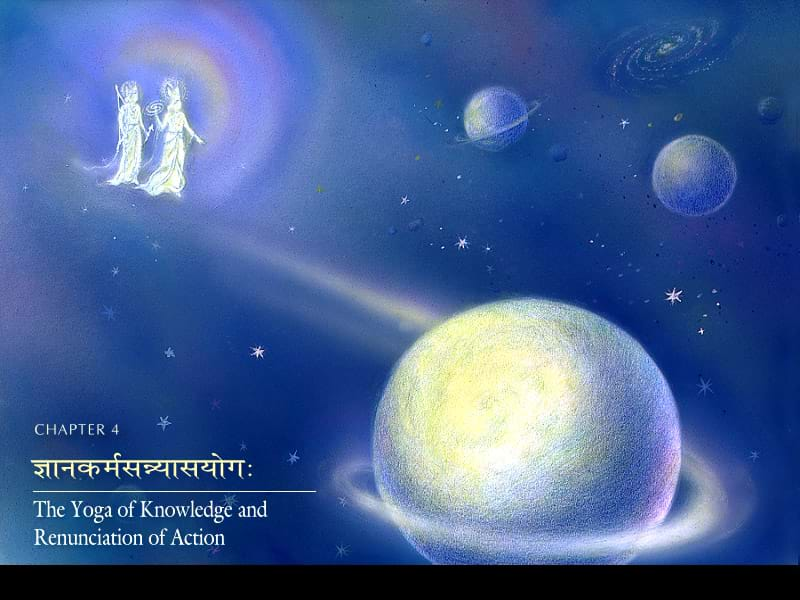
Chapter 4 illustration, titled ज्ञानकर्मसंन्यासयोगः
Illustration · Sushanto Nath, Sri Aurobindo Society

Chapter outline

Choose a range to read just those verses.

  1. 4·1–5The divine origin of the Gita's eternal Yoga.
  2. 4·6–15The truth and purpose of Avatarhood. Shri Krishna's self-revelation, His divine birth and action.
  3. 4·16–23The secret of Karma and Yoga.
  4. 4·24–33Various forms of Sacrifice, the divine principle of it.
  5. 4·34–42Spiritual Knowledge, its great value.
  6. 4·1–42Show all 42 verses

The verses

Showing verses 16–23 of 42 · Show all 42 verses

Śrī Bhagavān uvācaश्रीभगवानुवाच

  1. 4·16किं कर्म किमकर्मेति कवयोऽप्यत्र मोहिताः । तत्ते कर्म प्रवक्ष्यामि यज्ज्ञात्वा मोक्ष्यसेऽशुभात् ॥ १६ ॥kiṁ karma kimakarmeti kavayo’pyatra mohitāḥ, tatte karma pravakṣyāmi yajjñātvā mokṣyase’śubhāt.What is action and what is inaction, as to this even the sages are perplexed and deluded.
  2. 4·17कर्मणो ह्यपि बोद्धव्यं बोद्धव्यं च विकर्मणः । अकर्मणश्च बोद्धव्यं गहना कर्मणो गतिः ॥ १७ ॥karmaṇo hyapi boddhavyaṁ boddhavyaṁ ca vikarmaṇaḥ, akarmaṇaśca boddhavyaṁ gahanā karmaṇo gatiḥ.One has to understand about action as well as to understand about wrong action and about inaction one has to…
  3. 4·18, a key verseकर्मण्यकर्म यः पश्येदकर्मणि च कर्म यः । स बुद्धिमान्मनुष्येषु स युक्तः कृत्स्नकर्मकृत् ॥ १८ ॥karmaṇyakarma yaḥ paśyedakarmaṇi ca karma yaḥ, sa buddhimānmanuṣyeṣu sa yuktaḥ kṛtsnakarmakṛt.He who in action can see inaction and can see action still continuing in cessation from works, is the man of…
  4. 4·19यस्य सर्वे समारम्भाः कामसङ्कल्पवर्जिताः । ज्ञानाग्निदग्धकर्माणं तमाहुः पण्डितं बुधाः ॥ १९ ॥yasya sarve samārambhāḥ kāmasaṅkalpavarjitāḥ, jñānāgnidagdhakarmāṇaṁ tamāhuḥ paṇḍitaṁ budhāḥ.Whose inceptions and undertakings are all free from the will of desire, whose works are burned up by the fire…
  5. 4·20त्यक्त्वा कर्मफलासङ्गं नित्यतृप्तो निराश्रयः । कर्मण्यभिप्रवृत्तोऽपि नैव किंचित्करोति सः ॥ २० ॥tyaktvā karmaphalāsaṅgaṁ nityatṛpto nirāśrayaḥ, karmaṇyabhipravṛtto’pi naiva kiṁcitkaroti saḥ.Having abandoned all attachment to the fruits of his works, ever satisfied without any kind of dependence, he…
  6. 4·21निराशीर्यतचित्तात्मा त्यक्तसर्वपरिग्रहः । शारीरं केवलं कर्म कुर्वन्नाप्नोति किल्बिषम् ॥ २१ ॥nirāśīryatacittātmā tyaktasarvaparigrahaḥ, śārīraṁ kevalaṁ karma kurvannāpnoti kilbiṣam.He has no personal hopes, does not seize on things as his personal possessions…
  7. 4·22यदृच्छालाभसंतुष्टो द्वन्द्वातीतो विमत्सरः । समः सिद्धावसिद्धौ च कृत्वापि न निबध्यते ॥ २२ ॥yadṛcchālābhasaṁtuṣṭo dvandvātīto vimatsaraḥ, samaḥ siddhāvasiddhau ca kṛtvāpi na nibadhyate.He who is satisfied with whatever gain comes to him, who has passed beyond the dualities, is jealous of none…
  8. 4·23गतसङ्गस्य मुक्तस्य ज्ञानावस्थितचेतसः । यज्ञायाचरतः कर्म समग्रं प्रविलीयते ॥ २३ ॥gatasaṅgasya muktasya jñānāvasthitacetasaḥ, yajñāyācarataḥ karma samagraṁ pravilīyate.When a man liberated, free from attachment, with his mind, heart and spirit firmly founded in self-knowledge…

End of the chapter

ॐ तत्सदिति श्रीमद्भगवद्गीतासूपनिषत्सुब्रह्मविद्यायां योगशास्त्रे श्रीकृष्णार्जुनसंवादेज्ञानकर्मसंन्यासयोगो नाम चतुर्थोऽध्यायः ॥ ४॥

om tatsaditi śrīmadbhagavadgītāsūpaniṣatsubrahmavidyāyāṁ yogaśāstre śrīkṛṣṇārjunasaṁvādejñānakarmasaṁnyāsayogo nāma caturtho’dhyāyaḥ

Thus, in the Upanishad sung by the Lord, the science of Brahman, the scripture of Yoga, the dialogue between Sri Krishna and Arjuna, ends the fourth chapter entitled “The Yoga of Knowledge and Renunciation of Action”

Go to a verse

  1. 1
  2. 2
  3. 3
  4. 4
  5. 5
  6. 6
  7. 7
  8. 8
  9. 9
  10. 10
  11. 11
  12. 12
  13. 13
  14. 14
  15. 15
  16. 16
  17. 17
  18. 18
  19. 19
  20. 20
  21. 21
  22. 22
  23. 23
  24. 24
  25. 25
  26. 26
  27. 27
  28. 28
  29. 29
  30. 30
  31. 31
  32. 32
  33. 33
  34. 34
  35. 35
  36. 36
  37. 37
  38. 38
  39. 39
  40. 40
  41. 41
  42. 42